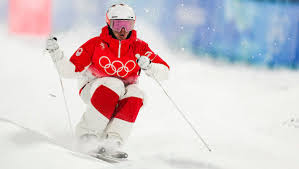
The skis hit the snow with a hollow thud.
For a heartbeat, that was the loudest sound in Livigno Air Park—louder than the roar of the crowd, louder than the music pulsing over the speakers, louder than the announcer’s voice still rising with the words “Olympic champion.”
Mikaël Kingsbury stood at the bottom of the moguls course, chest heaving, his skis now lying on the churned-up snow where he had flung them. The scoreboard above the finish line confirmed what he already suspected: 83.71 points. The same as Cooper Woods of Australia. Same score. Same peak of performance. But not the same colour of medal.
The tiebreaker—an invisible, unforgiving layer of math and judgment—had nudged the gold away from the Canadian who had defined an entire generation of moguls skiing and handed it to a 23-year-old underdog from down under. On paper, it was simple. Turns count for 60 per cent of a moguls run, with the two jumps and speed making up 20 per cent each. Woods had edged Kingsbury 48.40 to 47.70 in that critical category, earning just enough style in the fall line to tilt history in his favour.
On the snow, it felt anything but simple.
For Kingsbury, 33, from Deux-Montagnes, Que., this was supposed to be the perfect kind of ending—if there is such a thing in sport. He’d returned from a fall and a serious injury in September that, for a while, made the idea of another Olympics feel far away, if not out of reach entirely. Yet there he was, hurtling down another Olympic course in another Olympic final, chasing a second career gold medal and, maybe, a sense of completion.
Instead, he stood with a silver medal and a knot of conflicting emotions that even he couldn’t quite untangle in those first few seconds. “It was so close,” he would say later, calmer now, the medal around his neck. He talked about how proud he was of his run, how hard he had worked just to get back to this level. He said he felt amazing about his skiing. But in the heat of it, before the words and the interviews and the ceremony, the only honest reaction his body could offer was frustration—a brief, visceral rejection of the idea that perfection could be shared, yet rewarded differently.
Behind him, the course that had defined his night rose in a steep, icy wall. The line he’d just skied was etched there, invisible to everyone but him. Every turn, every compression, every breath was still written in his legs.
Kingsbury had arrived in Italy as the ultimate known quantity: the moguls GOAT, the man who turned the FIS World Cup podium into a familiar address and recently notched his 100th career World Cup victory in Val St-Côme, Que. It’s hard to overstate what that kind of sustained brilliance means in a sport where the smallest mistake can end a season. For a decade, Kingsbury had been the standard. Woods, by contrast, was the surprise. He’d shown promise, sure, and he’d stood on a World Cup podium once. But he had never beaten Kingsbury when it mattered most. Until now.
On the final run, Woods attacked the course with a mix of fearlessness and clarity that caught even veteran observers off-guard. His line was direct and aggressive. Where others seemed to react to the bumps, he seemed to anticipate them, threading his way down the field of moguls as if he’d been skiing that Italian hillside his whole life. At the bottom, he threw a fist in the air, then looked up.
83.71.
Then came Kingsbury. The Canadian’s run was characteristically sharp—precise edging, dynamic absorption, the kind of fluidity that has turned countless nights into coronations. He had known, even in the start gate, that this might be one of the last times he’d ever feel that electric quiet before a big Olympic run. He’d admitted as much before the competition: this was likely his last Olympics. The dual moguls event was still to come, but after that, this chapter would be closing.
So he pushed. Down through the first section of bumps, knees snapping like coiled springs, torso calm above the storm. Off the first jump, landing clean. Through the middle section, the hardest part of any moguls course, he was in that elusive space all skiers chase—where instinct and training merge, and time seems to narrow to just the next turn, the next bump, the next breath. At the bottom, he crossed the line and let the tension leave his body in a shout.
The wait felt longer than it was. When the number finally flashed and the tie became clear, there was a moment when the entire venue seemed to inhale together. The result—settled by the deeper calculus of the judges’ breakdown—took a beat to sink in. Woods, not Kingsbury, would be the Olympic champion. Kingsbury, Olympic silver medallist—for the third time.
His fourth Olympic medal overall. In that instant, Kingsbury did what few athletes ever have to do: absorb the shock of a razor-thin loss while also understanding, somewhere underneath, that he had just made history. No man in freestyle skiing had ever stood on the Olympic podium four times before.
Up in the stands, Australian fans were losing their minds. One waved an inflatable wallaby. Woods, realizing he had just upset the greatest moguls skier of all time, broke down in tears, his face buried in his gloves. “It’s not often you get one over Mikaël,” he would say, almost in disbelief. And he was right. It’s the kind of sentence that, until that night, felt hypothetical.
For Kingsbury, the feelings were more complicated.
He walked off the snow, gathered himself, and when he stepped onto the podium later in Livigno, the frustration had softened into something else. The crowd saw the familiar smile, the easy wave, the quiet pride of an athlete who has nothing left to prove, yet still feels every missed opportunity.
“I’m getting older,” he admitted candidly. At 33, he’s a veteran in a sport that tests your body every single run. The injury in September had forced him, for the first time in a long time, to entertain the possibility that he might not come back to this level. The rehab had been tedious, painful, repetitive. The kind of work that no camera ever shows, but that medals are built on.
He talked about his team—coaches, physios, friends—who refused to let him settle for anything less than his best, who believed he could be back on an Olympic podium even when the timeline looked tight and the doubts were loud. Whatever frustration he might have felt about the tiebreaker didn’t touch that gratitude. Under the bright lights of the victory ceremony, as the announcer read his name and the medal was placed around his neck, Kingsbury held the silver up for the crowd. The disappointment was still in there somewhere, but so was something else: perspective.
This was a medal earned not just on a single run, but over years—through sleepless nights, lonely training sessions, and the decision, over and over again, to keep chasing perfection in a sport where perfection is judged in tenths of a point. On the results sheet, his résumé now reads like something out of a fantasy career: four Olympic medals—gold from PyeongChang 2018, silver from Sochi 2014, Beijing 2022, and now Milano-Cortina 2026. The first man in his discipline to ever do it.
Behind him on the leaderboard, Japan’s Ikuma Horishima claimed bronze with 83.44, just a whisper behind the two leaders. Further down, Canada’s Julien Viel of Quebec City finished a strong sixth with 79.78, while Elliot Vaillancourt of Drummondville bowed out earlier, 14th in the first round of the final.
The depth of Canadian moguls talent was on display. So, too, was the brutal narrowness of Olympic margins. And still, Kingsbury’s story in these Games isn’t finished. In a few days, he will climb into the start gate again for the men’s dual moguls event. This time there will be no tiebreaker mathematics, no shared scores. Duals is a pure test of head-to-head nerve—two skiers, one course, whoever crosses the line first with the better skiing moves on.
Kingsbury has already said what he intends to do with that final Olympic run: enjoy it. Ski with no regrets. Empty the tank. Perhaps that’s the quiet power of this silver medal. It’s not a consolation prize, not a symbol of something lost, but proof that even in the twilight of a storied career, with an injury in the rear-view mirror and younger challengers rising fast, Mikaël Kingsbury is still capable of pushing the sport to its limit.
On that cold night in Livigno, as the crowd began to thin and the course crew reshaped the moguls under floodlights, Kingsbury slipped away from the noise and the cameras. Somewhere in the stillness, he knew: medals tarnish, scores fade, but the feeling of skiing your best run when it matters most—that stays. Gold or silver, shared points or clear victory, he had done what he came to do.
He had found, one more time, the perfect line.